

Table of Contents
In a crypto market dominated by hype cycles, meme tokens, and short-term narratives, it’s easy to miss out on projects quietly laying the groundwork for long-term success. Algorand (ALGO) is one such project. It doesn’t grab headlines with viral trends or celebrity partnerships. Instead, it focuses on scalable infrastructure, energy efficiency, institutional adoption, and real-world utility.
Founded by Turing Award winner Silvio Micali, Algorand is a technically advanced Layer 1 blockchain that solves some of the most fundamental problems in the space: scalability, decentralization, and security. In this deep dive, we’ll break down what makes Algorand so unique, why it matters, and where it might fit into the broader Web3 ecosystem.
What is Algorand?
Algorand is a Layer 1 blockchain that uses a unique consensus mechanism called Pure Proof of Stake (PPoS). Designed for speed, security, and decentralization, it supports smart contracts, DeFi applications, real-world asset tokenization, and more. It was created in 2017 and launched in 2019 with the goal of being the foundational layer for the future of finance and digital interactions.
The project stands out because of its commitment to transparency, sustainability, and institutional-grade reliability. With transaction finality in under five seconds and extremely low fees, Algorand is optimized for enterprise-level adoption without sacrificing decentralization.
The Mind Behind the Blockchain: Silvio Micali
Silvio Micali, the founder of Algorand, is one of the most respected names in cryptography and computer science. He is a professor at MIT and has contributed to major cryptographic breakthroughs, including:
- Zero-Knowledge Proofs
- Verifiable Random Functions
- Probabilistic Encryption
He received the prestigious Turing Award in 2012 and holds over 45 patents. Micali brings academic integrity and decades of research experience to the project, setting a high standard for Algorand’s development.
How Pure Proof of Stake Works
Unlike traditional Proof of Stake (PoS) systems where validators are selected based on the amount of tokens staked (which can lead to centralization), Algorand uses a system where validators are chosen randomly and anonymously. Every ALGO token holder has a chance to be selected, and while having more ALGO increases your chances, no one can predict who will be selected next.
This randomness makes Algorand more resistant to attacks and improves decentralization. The network can continue functioning smoothly even if up to one-third of the participants go offline or act maliciously, thanks to its Byzantine Agreement protocol.
Key features of Algorand’s PPoS:
- Decentralized validator selection
- No slashing (validators are not penalized)
- Randomized, fair validator selection
- Instant finality with no forks
Speed, Security, and Sustainability
Algorand is built to handle high throughput. It supports over 10,000 transactions per second (TPS), making it suitable for real-world financial applications.
One of its key advantages is instant finality. Once a block is added, it is immediately considered final. There’s no need to wait for multiple confirmations, reducing the risk of double spending and making the network highly efficient for payments.
In addition, Algorand is one of the few blockchains that is carbon-negative. It partners with organizations to offset more carbon than it emits. In a world increasingly focused on environmental impact, this is a powerful differentiator.
Real-World Use Cases
Algorand is not just a theoretical blockchain; it’s actively being used in multiple sectors.
1. Fractional Real Estate (Lofty)
Lofty enables fractional ownership of rental properties on the Algorand blockchain. This opens up real estate investing to a global audience and reduces the barriers to entry.
2. DeFi (Folks Finance)
Folks Finance is the largest DeFi protocol on Algorand by total value locked. It offers lending, borrowing, and staking services in a decentralized environment.
3. Healthcare (LabTrace)
LabTrace uses Algorand for secure storage and verification of medical data, improving trust and transparency in healthcare systems.
4. Supply Chain (WholeChain)
WholeChain uses Algorand to track and verify goods across complex supply chains. This enables transparency for industries like agriculture, seafood, and retail.
5. Government and Public Sector
The government of Plateau State in Nigeria has partnered with Algorand to explore blockchain solutions for public services, including healthcare and governance.
6. Clean Energy (ENEL Group)
Europe’s largest energy company, ENEL Group, is working with Algorand on projects related to renewable energy tokenization.
7. Ticketing (Travala)
Travala is using Algorand to issue NFT-based event tickets, making them transferable and traceable on-chain.
Ecosystem Overview
While Algorand’s ecosystem is not as large or flashy as Ethereum or Solana, it is steadily growing. It includes:
- Wallets: Pera Wallet, Dfly Wallet
- DeFi: Folks Finance, Tinyman
- NFTs: AlGoanna, Shufl
- Tokenization platforms: Lofty, ClimateTrade
- Developer tools: Algokit, SDKs, APIs
The project has also launched its own developer accelerator program and hackathons around the world, with a focus on Latin America, Europe, and Africa.
Governance and xGov
Algorand uses a community governance model where ALGO holders vote on important network decisions, including funding proposals, protocol upgrades, and policy shifts. It also has an advanced layer called xGov, or Extended Governance, for those who want deeper involvement.
Governance rewards are offered to incentivize participation, and users can vote directly through supported wallets or the Algorand Governance Portal.
Tokenomics
- Max Supply: 10 billion ALGO
- Circulating Supply: ~8.7 billion ALGO
- Inflation: Declining emissions, with plans to be fully distributed by 2030
- Uses: Transactions, staking, governance, smart contract fees
The Algorand Foundation holds a portion of the supply for ecosystem development and governance. However, there has been criticism around transparency, especially regarding exact wallet holdings and token release schedules.
A blockchain scanner shows that a small number of wallets hold significant ALGO quantities. Although the team has addressed this by making some data public, better communication and wallet labeling would go a long way in increasing trust.
Developer Experience
Algorand supports smart contract development in multiple modern programming languages, including Python and TypeScript. This lowers the barrier for new developers.
However, it is not EVM-compatible, which means Ethereum-based applications can’t be easily ported to Algorand. This has limited its exposure to the broader DeFi and NFT developer community.
That said, Algokit and upcoming SDK updates aim to streamline the development process and increase accessibility.
Marketing and Community
This is one of Algorand’s weaker areas. While the project is highly respected in academic and institutional circles, its retail presence is limited.
- Its Medium blog has not been updated since 2022.
- Community activity on Discord and Telegram is moderate.
- Algorand uses a “pull” marketing strategy rather than aggressive influencer campaigns or viral tactics.
In a space driven by attention, this conservative approach can cause it to fly under the radar—even though it may be exactly what institutions prefer.
Roadmap Highlights
The 2025 roadmap includes:
- Algokit 4.0 release for streamlined development
- Strengthened governance tools and xGov expansion
- Tokenized finance initiatives
- Interoperability with other chains via Wormhole
- Decentralized identity systems
- Exploration of AI agents on-chain
These goals suggest a clear and focused plan to continue building a professional, reliable blockchain ecosystem.
Key Partnerships
- Coin Banks: Banking infrastructure in Latin America
- Identity Foundation: Digital ID initiatives
- Nigeria’s Plateau State: Government blockchain applications
- Paycode: Financial inclusion in underserved regions
- Blockchain Association: Policy and industry standards
- ENEL Group: Clean energy projects in Europe
These relationships show that Algorand is focused on long-term, high-impact collaborations.
Pros and Cons
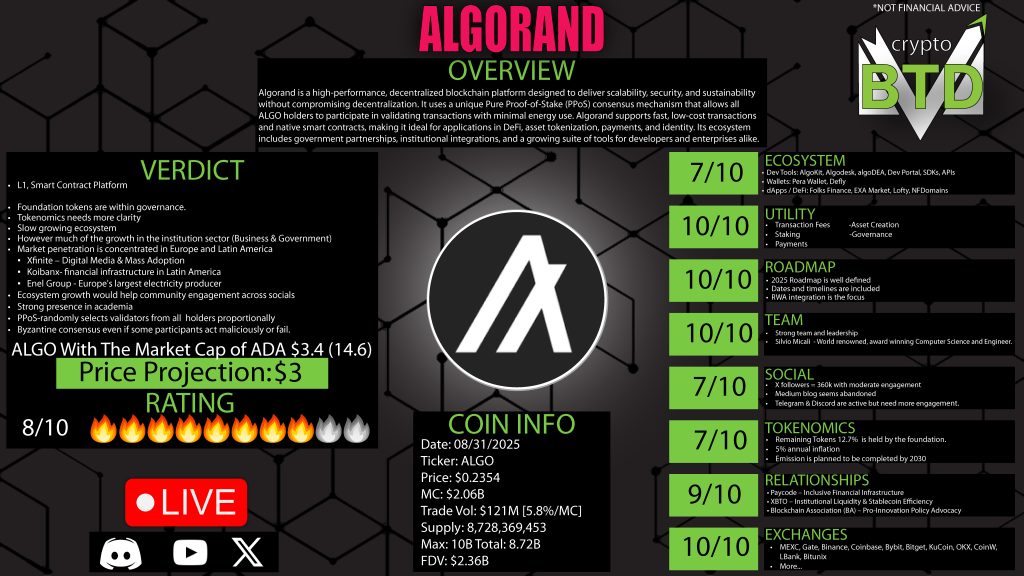
Pros
- Founded by a Turing Award-winning cryptographer
- Pure Proof of Stake provides strong decentralization and fairness
- Carbon-negative and energy efficient
- Fast transaction speeds with instant finality
- Real-world use cases across multiple industries
- Active institutional and government partnerships
- Clear roadmap and development strategy
Cons
- Slow ecosystem growth compared to other L1s
- Weak retail marketing and social media presence
- Limited North American adoption
- Token distribution transparency needs improvement
- Not EVM-compatible, reducing app portability
Conclusion
Algorand (ALGO) is not trying to be the flashiest blockchain on the market and that’s exactly what makes it powerful. It is built on rigorous science, led by world-class experts, and focused on real-world adoption.
Whether it’s enabling fractional home ownership, powering green energy initiatives, or helping governments modernize services, Algorand is quietly building a future where blockchain is more than speculation.
For anyone interested in the long game, Algorand represents a different kind of value: not just market cap and TVL, but trust, transparency, and infrastructure that lasts.
If you haven’t looked at Algorand lately, it might be time to take a second look. This blockchain isn’t just keeping up with the industry. In many ways, it’s setting the standard.


0 Comments