

Table of Contents
Introduction: A New Economy for Science
In the fast-paced world of Web3, few projects stand out by aiming to disrupt real-world institutions like academia and scientific publishing. ResearchHub does just that. Positioned as a decentralized platform for funding, peer reviewing, and publishing scientific research, ResearchHub is building a new kind of economy for science.
The traditional model of scientific research is riddled with problems: limited access to funding, paywalled publications, biased peer review systems, and centralized control by legacy publishers. Researchers often struggle to gain recognition or financial support, while large academic journals profit from their work without fair compensation. ResearchHub, powered by its native cryptocurrency ResearchCoin (RSC), aims to change this paradigm.
By introducing tokenized incentives and decentralized governance, ResearchHub proposes a Web3-native solution to some of academia’s biggest problems. Let’s explore how ResearchHub works, what ResearchCoin is used for, and why this project could reshape the future of open science.
What Is ResearchHub?
At its core, ResearchHub is a decentralized scientific collaboration platform designed to transform how knowledge is created, evaluated, and shared. Inspired by platforms like GitHub, Reddit, and Stack Overflow, ResearchHub gives researchers a way to collaborate openly and transparently while earning rewards for their contributions.
Through ResearchHub, users can:
- Publish open-access scientific papers without traditional gatekeepers
- Earn rewards in RSC for peer reviewing or commenting on research
- Create and manage proposals for funding groundbreaking ideas
- Participate in governance through a decentralized autonomous organization (DAO)
- Collaborate on documents using the platform’s built-in “Notebook” tool
The goal is to shift the incentive structure in science from a closed, paywalled system to an open, collaborative ecosystem driven by merit and community support.
The Role of ResearchCoin (RSC)
ResearchCoin (RSC) is the native token that powers all activity on ResearchHub. It is an ERC-20 token deployed on Base, an Ethereum Layer 2 network created by Coinbase. This choice allows for faster and cheaper transactions compared to the Ethereum mainnet.
RSC is used in several ways:
- Peer Review Payments: Users can earn RSC for providing high-quality reviews of published research. This incentivizes thoughtful, helpful feedback that benefits the entire scientific community.
- Bounties: Individuals or organizations can post research questions or challenges, attaching RSC as a reward. Contributors can then solve the challenges and earn the bounty.
- Tipping and Donations: Users can tip researchers or donate RSC to support particular studies or proposals.
- Governance: RSC holders can vote on major platform decisions, such as funding allocations, development priorities, and system upgrades.
- Access to Tools: Holding RSC can unlock premium features on the platform, such as advanced collaboration tools, visibility boosts, or analytics.
This token-driven economy ensures that all stakeholders are rewarded fairly for their efforts, and the system becomes increasingly decentralized over time.
How ResearchHub Works
ResearchHub’s platform is structured around three main functions: fund, earn, and publish.
- Fund
- Researchers can submit proposals for funding.
- Donors (philanthropists, institutions, or individuals) can browse and contribute RSC to proposals they believe in.
- Real-time updates and transparent reporting allow donors to track how funds are used and monitor project progress.
- Earn
- Peer reviewers are compensated with RSC for evaluating papers.
- Participants can complete bounties or contribute comments, reviews, or feedback.
- Reputation systems reward quality contributors, which helps create a merit-based ranking system on the platform.
- Publish
- Researchers can submit their work to the ResearchHub Journal, an open-access, decentralized journal.
- Submissions go through open peer review, and preprint options allow immediate visibility.
- Authors retain more control, and publication fees are significantly lower compared to traditional journals.
Tokenomics and Distribution
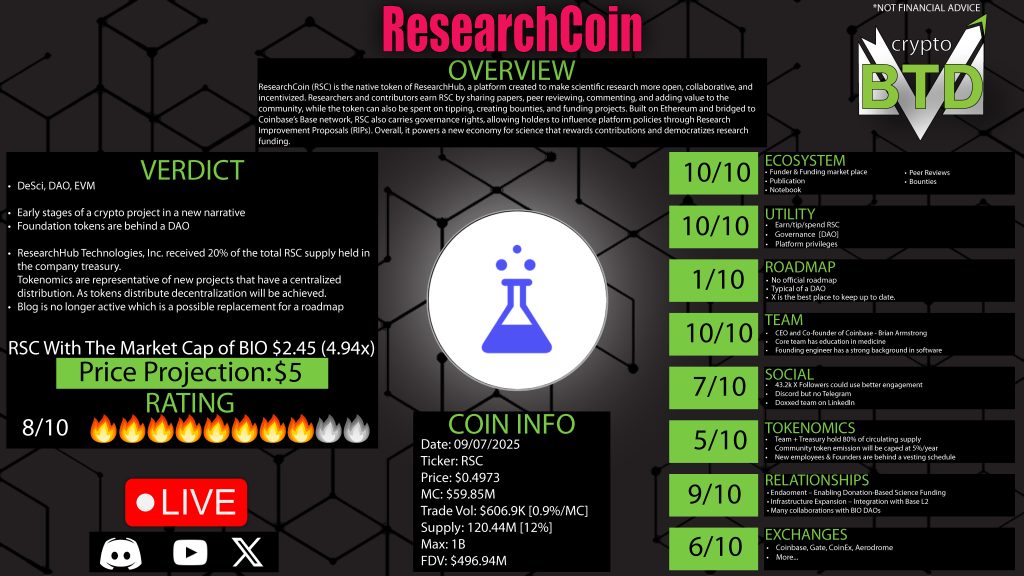
ResearchHub has a total capped supply of 1 billion RSC tokens. These tokens are distributed over a 12-year schedule. Here’s the general allocation breakdown:
- 60% to the community: distributed via peer review rewards, bounties, DAO grants, and incentives.
- 20% to ResearchHub Inc.: used for development, infrastructure, and long-term sustainability.
- 10% to the founders: with multi-year vesting schedules.
- 10% reserved for future employees: also with vesting over time.
The emission rate for community rewards is capped at 5% annually, preventing sudden inflation. The vesting schedules for the team and founders are structured to promote long-term commitment rather than short-term profit-taking.
However, early in the project’s life cycle, a significant portion of circulating RSC is still held by ResearchHub Inc. and core team members. While this is fairly common in Web3 startups, it does create centralization risks in the short term, especially regarding DAO voting.
Governance and the DAO Model
ResearchHub is governed by its community through a DAO. Token holders can propose and vote on changes to the platform, including:
- Adjusting peer review incentives
- Allocating funds for specific research topics
- Adding new platform features
- Modifying the journal’s review guidelines
In theory, this allows ResearchHub to become fully decentralized over time. However, as mentioned, because early token distribution is skewed toward insiders, full decentralization is still a work in progress.
As more tokens are distributed to the community through participation, the influence of the founding team will decline, gradually shifting control to researchers and contributors worldwide.
Academic Adoption and Institutional Backing
One of ResearchHub’s strengths is its growing user base of actual scientists and researchers. Contributors from major universities like Harvard, Cornell, and UCLA are already using the platform. This is a major validation point.
Unlike some Web3 projects that remain theoretical or speculative, ResearchHub already has:
- Over 1.2 million in research grants awarded
- Thousands of active users
- Partnerships and mentions across academic circles
- Real publications being peer-reviewed and published on-chain
This signals that the platform is not just another crypto idea but is actually delivering value to its target users.
Team and Leadership
Perhaps the most influential figure behind ResearchHub is Brian Armstrong, co-founder and CEO of Coinbase. Armstrong is also a co-founder of ResearchHub and provides key strategic support.
While not listed publicly on the ResearchHub team page, Armstrong’s involvement is well-documented and gives the project enormous credibility. His experience with Coinbase and Base offers ResearchHub an edge in both regulatory navigation and blockchain integration.
Other team members include PhDs in biomedical sciences, neuroscience, engineering, and software development. The team is young, ambitious, and highly technical.
Although many of the core contributors are early in their careers, their academic backgrounds and energy align well with the mission of disrupting the outdated scientific publishing industry.
Platform Experience and Interface
ResearchHub’s user interface is clean, intuitive, and accessible. It resembles modern web platforms, making it easier for non-crypto users to engage.
Users can browse trending research, upvote or comment, and even earn bounties directly from the home page. The platform also includes tools for collaboration (like the Notebook), a leaderboard system for reputation, and a built-in journal.
However, onboarding users who are new to Web3 can still be a challenge. Wallet integration, RSC transfers, and DAO voting may be intimidating for researchers unfamiliar with crypto. Future updates that improve UX for non-technical users would enhance adoption.
Roadmap and Communication Gaps
While the platform itself is impressive and functional, one major area of weakness is communication. There is currently no publicly available roadmap.
An earlier Medium blog was taken down, and the team has shifted communication to the platform itself and X (formerly Twitter). Unfortunately, X engagement is low, and the blog migration link is broken.
This creates uncertainty about what’s coming next and makes it harder for potential users or investors to align with the project’s vision.
A detailed roadmap or even a consistently updated blog would go a long way in improving trust and transparency.
Partnerships and Ecosystem Connections
ResearchHub has already begun integrating with the broader DeSci (Decentralized Science) movement. Notably, it has an informal relationship with Bio.xyz, a launchpad for scientific DAOs.
Both platforms are committed to building Web3-native infrastructure for scientific funding and governance. The fact that ResearchHub is deployed on Base (Coinbase’s Layer 2) also makes it easier to onboard users familiar with Coinbase.
Additional partnerships or listings on major exchanges could be next, especially as ResearchHub gains traction.
Pros of ResearchHub and ResearchCoin (RSC)
- Strong Founding Team: Led by Brian Armstrong, a major figure in the crypto space, giving the project legitimacy and connections.
- Real Utility: ResearchCoin (RSC) is not just a speculative asset. It powers the entire ResearchHub ecosystem and has defined use cases for peer review, publishing, governance, and funding.
- Academic Adoption: Researchers from major universities are already using the platform, providing early validation that it solves real problems.
- Open Science Mission: The project promotes open-access science and fair compensation for researchers, addressing deep-rooted issues in academia.
- Web3-Native Design: Built on Base for fast and cheap transactions, and governed by a DAO.
- High-Quality Documentation: Clear, transparent technical documentation is available for developers and users.
Cons and Areas to Improve
- Token Centralization: A large portion of RSC is still controlled by the founding team and treasury wallets. This limits decentralization in the short term.
- No Public Roadmap: Lack of a visible roadmap or updated blog creates uncertainty about the platform’s direction.
- Low Social Engagement: Despite strong fundamentals, the project has little buzz on Twitter/X and no Telegram presence.
- Crypto Complexity for Scientists: For users unfamiliar with blockchain, onboarding is still complicated. Better UI/UX could improve adoption.
- DAO Still Evolving: While governance exists, real decision-making power is currently concentrated. More token distribution is needed for a truly community-driven DAO.
Conclusion: A Web3 Solution to Real-World Problems
ResearchHub is not just another crypto project. It’s a bold attempt to fix a broken system in scientific research. With ResearchCoin (RSC) at its center, the platform introduces new incentives for openness, collaboration, and fair compensation.
By integrating blockchain technology into peer review, publishing, and funding, ResearchHub brings real innovation to a field that desperately needs it. While challenges remain in communication, decentralization, and user onboarding, the foundation is strong.
With a credible team, active academic users, and a vision aligned with the core principles of Web3, ResearchHub is one of the most promising projects in the emerging DeSci narrative.
If DeSci becomes a major pillar of the next crypto cycle, ResearchHub and ResearchCoin are well-positioned to lead the charge.





0 Comments